Habits & productivity15 October 2026 · 5 min read
Your week, sorted: a simple 20-minute planning routine
Twenty minutes on Sunday or Monday is enough to plan a week you’ll actually keep. In a large review, time management went with better results and, even more, with feeling better.

The short answer
Take 20 minutes on Sunday or Monday: look back at last week, pick one big thing for this week, put the time for it in your calendar, and write an if-then plan for what’s most likely to get in the way. A large review found that time management goes with better performance and, even more, with feeling better. Telling a buddy your plan makes it stick.
Monday morning. Forty unread emails, a meeting at ten, and somewhere in there the thing you actually care about: the training, the side project, the course. By Friday, it’s been pushed to “next week” again.
A short weekly plan won’t fix everything. But it gives the important thing a time and a place before the week fills up on its own.
Does planning actually work?
A meta-analysis of 158 studies with more than 53,000 people1 looked at time management at work and in studies. It went with moderately better performance. The surprise was that it went with wellbeing even more: higher life satisfaction and less distress. Most of these studies show links rather than cause and effect, but the direction is encouraging.
There’s also a reason planning feels so good. In lab experiments2, unfinished goals kept popping into people’s heads and distracted them from other tasks. Making a specific plan for the goal made that nagging go away, even before they’d done any of the work. A plan tells your brain: it’s handled, you can stop reminding me.
The 20-minute weekly plan
20 minutes, once a week
- Look back · 5 min
- Pick one big thing · 5 min
- Put it in your calendar · 5 min
- Plan for the obstacle · 5 min
1. Look back (5 minutes)
What did you get done last week? What didn’t happen, and why? No judgement, just notes. If something got in the way twice, that’s your obstacle for step 4.
2. Pick one big thing (5 minutes)
Not seven priorities. One thing that would make you think “good week” on Sunday. “Finish the pricing page.” “Three runs, including the long one.” Everything else is a bonus.
3. Put it in your calendar (5 minutes)
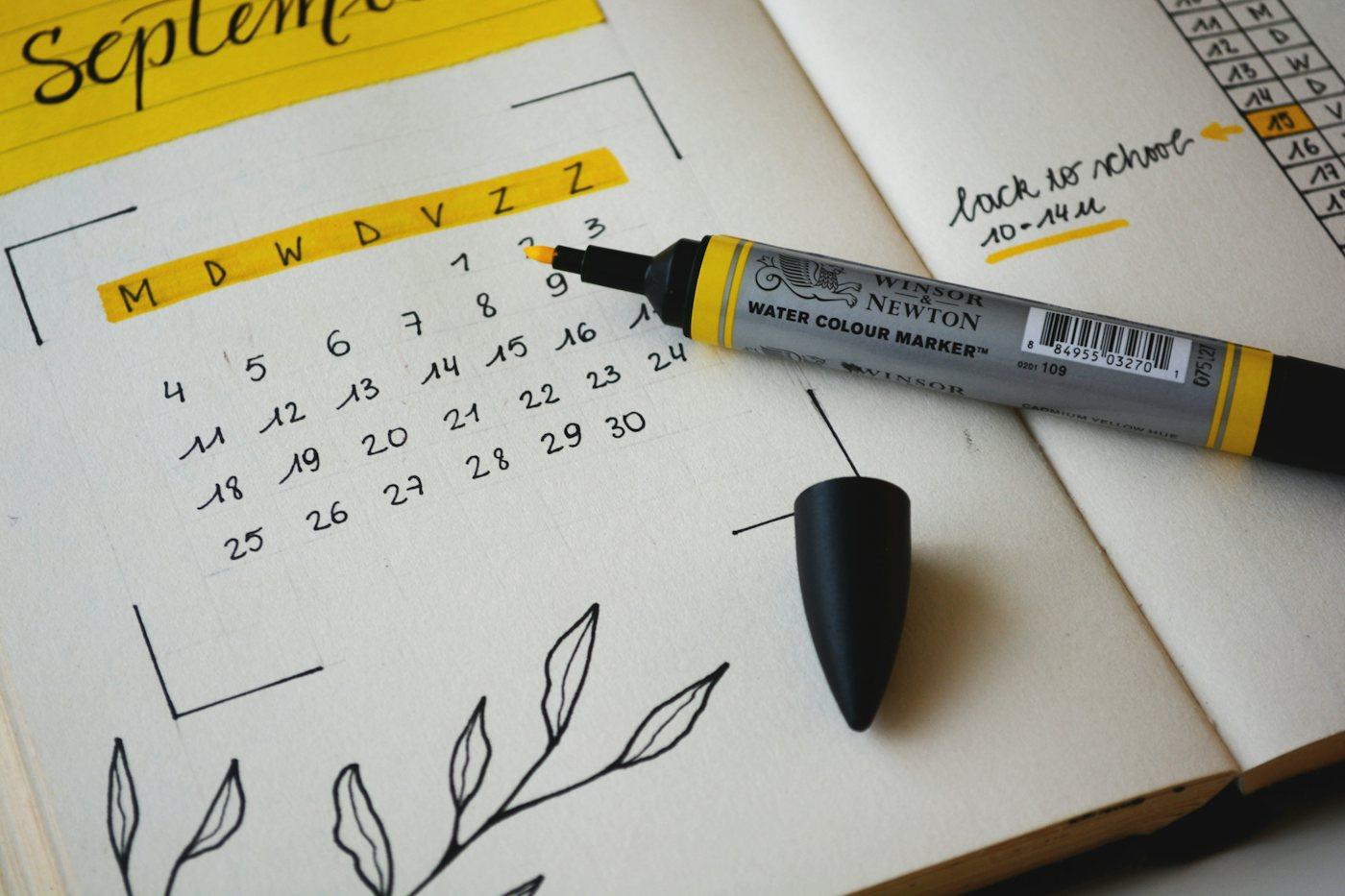
Give the big thing actual slots, like meetings: “Tuesday 7:00–8:00, Thursday 19:30–21:00.” If it doesn’t have a time, it’s a wish.
4. Plan for the obstacle (5 minutes)
Write one if-then plan: “If the Thursday slot gets taken, then I move it to Saturday morning.” Plans like this clearly improve follow-through3.
Send it to someone
Last step, thirty seconds: send your one big thing to your accountability partner. “This week: pricing page, Tuesday and Thursday.” Reporting progress to someone else makes keeping track of it more effective4, and on Sunday you’ll both know how it went.
One sheet of paper is enough for all four steps. Keep it by your desk.
What a plan looks like in real life
Lena is a freelance designer training for her first 10K. Her Sunday plan takes one sheet of paper:
- Looking back: two of three runs done. Thursday’s run didn’t happen because a client call ran late, the second week in a row.
- One big thing: three runs, including a 50-minute long run on Saturday.
- In the calendar: Tuesday 7:00, Thursday 7:00 (moved from the evening), Saturday 9:30.
- If-then: if a run gets cancelled, then I do it the next morning at 7:00.
- Sent to her buddy: “Three runs this week, Thursday moved to the morning because evenings keep failing.”
Nothing fancy. But the obstacle from last week now has a fix, and someone knows about it.
When to plan
There’s no perfect time, only one you’ll stick to. The three most popular:
- Friday afternoon: last week is fresh in your mind, and you start the weekend with a clear head.
- Sunday evening: the classic. Works well if you like a calm start to Monday.
- Monday morning: good if weekends are busy, as long as you do it before opening your inbox.
Pick one and make it a fixed appointment. Pair it with something nice: your favourite coffee, a playlist, the sofa by the window.
Leave room for real life
The most common planning mistake is filling every hour. Then one late meeting knocks over the whole week. A few ways to build in slack:
- Plan your big thing for two or three slots, not one. If one slips, you still have the others.
- Leave one evening completely free. It becomes your buffer, or a well-earned rest.
- Be honest about energy. Don’t schedule deep thinking right after your longest meeting day.
A five-minute check each morning
The weekly plan sets the direction. A short daily check keeps you on it. Each morning, before email:
- Look at today in your calendar.
- Is there a slot for this week’s big thing? Protect it.
- Write down the top three tasks for today. Just three.
If the day blows up, you’ll at least know what to rescue.
Why weekly plans fail
When a planning habit dies, it’s usually for one of these reasons:
- Too many priorities. Seven “important” things means none of them is.
- Tasks without times. A list isn’t a plan until it’s in the calendar.
- No look back. Without step one, you repeat the same mistakes every week.
- Skipping a week, then giving up. Missed a Sunday? Do a two-minute version on Monday and carry on.
You don’t need an app for any of this. A notebook or your normal calendar is enough. The best system is the one you’ll still use in March.
Someone to plan with
Pactful pairs you by hand with someone who’s working on a goal of their own, ideally close by. Many pairs swap their weekly plan on Monday and check in at the end of the week. We’re starting in Hamburg, Amsterdam, Rotterdam, The Hague and Utrecht.
Got a goal? Let’s find the person who helps you make it happen.
Find my goal buddy →Or just say hi, or write to hello@pactful.net
Sources
We checked these sources ourselves. Where a study is small or not peer-reviewed, we say so.
- Aeon, B., Faber, A., & Panaccio, A. (2021). Does time management work? A meta-analysis. PLOS ONE, 16(1), e0245066. doi.org/10.1371/journal.pone.0245066Open access. Most of the included studies were correlational.
- Masicampo, E. J., & Baumeister, R. F. (2011). Consider it done! Plan making can eliminate the cognitive effects of unfulfilled goals. Journal of Personality and Social Psychology, 101(4), 667–683. doi.org/10.1037/a0024192Lab experiments with students.
- Gollwitzer, P. M., & Sheeran, P. (2006). Implementation intentions and goal achievement: A meta-analysis of effects and processes. Advances in Experimental Social Psychology, 38, 69–119. doi.org/10.1016/S0065-2601(06)38002-1
- Harkin, B., Webb, T. L., Chang, B. P. I., et al. (2016). Does monitoring goal progress promote goal attainment? A meta-analysis of the experimental evidence. Psychological Bulletin, 142(2), 198–229. doi.org/10.1037/bul0000025
Know someone who needs this?
Send it to a friend, or put it in your story.
The Instagram button makes an image for your Instagram or WhatsApp story. On a computer, it downloads.